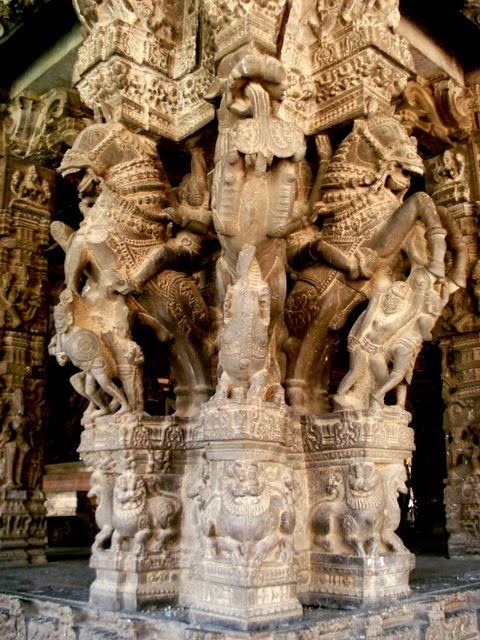
Sri srinivasa perumal temple -serangoon road singapore

Sri srinivasa perumal temple serangoon road  singapore


The history of Sri Srinivasa Perumal temple dates back to the late 1800s when influential community leaders like Mr Arunachala Pillay, Mr Cootaperumal Pillay, Mr Ramasamy Pillay, Mr Appasamy Pillay, Mr Chockalingam Pillay and Mr Ramasamy Jamidar, all of whom had close working links with the East India Company, wanted to build a Hindu temple for Vaishnavite worship.

These men got together and purchased a piece of land measuring 2 acres 2 woods and 24 poles from the East India Company in 1851 for 26 rupees and 8 annas (at that period of time Indian currency was still used in the Settlement of Singapore). The temple they built in 1885 was referred to as the Narasinga Perumal Kovil.

Following the construction of the original temple structure, 2 adjoining parcels of land were later obtained for the temple’s needs. In 1894, devotees Mr Moona Sithumbaram Pillay and Mr Vinasithamby Murugesu purchased a 25,792 square feet piece of land which they donated to the temple. The second piece of adjoining land measuring 3,422 square feet was obtained by the Mohammedan Hindu Endowments Board, MHEB (under whose administration the temple was from 1907) from the East India Company on 15th August 1912 on a 999 year lease at an annual fee of 1 Straits Settlement dollar.

The original temple structure remained unchanged until the early 1950s. In 1952, the MHEB decided to rebuild and reinstate the Temple. Redevelopment was only carried out in the early 1960s when well known Indian community leader and philanthropist Mr P. Govindasamy Pillay financed much of the works. Mr Pillay is credited with building the first two storey marriage hall within the temple. It was officially opened by Enche Yusoff Bin Ishak, the first president of Singapore on 19th June 1965.

The present building minus the Pillaiyar sanctum, Rajagopuram (grand tower entrance) and the covered walkway were completed in 1966. At this juncture, many elders advised that the main deity of the temple be changed from the imposing Sri Narasimha to the gracious Sri Srinivasa Perumal. The temple was thus renamed Sri Srinivasa Perumal Temple.

Although financial constraints had prevented the addition of a Rajagopuram to the façade of the temple in the early days, in 1979, Rajagopuram was erected. All costs for the entire construction and renovation works in the 1970s redevelopment phase were generously borne by Mr P Govindasamy Pillay.

In 1978, Sri Srinivasa Perumal Temple was declared a National Monument by the Preservation of Monuments Board.

The temple underwent major facelifts in 1987, 1992 and 2005. During the different phases of redevelopment, improvements were made to the façade and facilities to meet imperative devotee needs. Visitors to the temple today can witness the painstaking efforts undertaken by the temple’s successive management committees to ensure that its conservation status was maintained. From well laid out sanctums, rich sculptural embellishments to an ornate mandapam (pillared pavillion) built for the worship of processional deities, these and many more new features make the temple an embodiment of Hinduism. 

Some of the major festivals celebrated here are Thaipusam, Navarathiri, Vaikunda Ekathesi and Purattasi Sani.


To perform pooja in this temple pls contact us in doshanivarthi@gmail.com

Sri Veera Raghava Swami temple

Sri Veera Raghava Swami temple

Moolavar             :               Veera Raghava Perumal – Evvulkidandhan
                Urchavar              :               Veera Raghavar
                Amman / Thayar              : Kanakavalli
                Thala Virutcham               :               -
                Theertham         :               Hrudhapadhani
                Agamam / Pooja              : Pancharathiram
                Old year               :               1000-2000 years old
                Historical Name                :               Evvulur
                City        :               Tiruvallur
                District  :               Tiruvallur
                State     :               Tamil Nadu


To perform pooja in this temple pls contact us in doshanivarthi@gmail.com

The temple is praised in the Prabandham hymns of Tirumangai Azwar, Tirumazhisaipiran and Vaishnavite Acharya Sri Nikamanta Maha Desikan.

The temple witnesses a huge devotee crowd in thousands during the two Brahmmotsavams, the first of 10 days in Chithirai (April-May) and the second 10 days in Thai covering January-February. The crowd is equally big for the Pavithra Utsav lasting seven days. Besides these, Thai new moon day, Vaikunda Ekadasi in December-January, Tamil and English new year days, Deepavali and Pongal are celebrated in the temple.

Abishek to Lord is performed with perfumed oil only. Hruthapadhani spring is considered more sacred than the holy Ganga and it is believed that it cleanses devotees even from the very thinking of a sin.

Lord Veera Raghava Perumal is all merciful a physician.  Any sick person praying here continuously on three new moon days is cured of diseases as stomach pain, defects in hands and legs and fever.  Devotees also pray for child boon and happy wedding and reliefs from any untold hardship and suffering.

Devotees offer Papli Tupatti – an upper cloth to Perumal. This is not available in shops. This is sold in the temple office only priced at Rs. 300. Devotees also offer discs embossed with some figures as eye, full figure, house etc. They offer special archanas and aradhanas and distribute nivedhanas to visitors. Devotees also offer 9 yard length silk sari to Mother. For removal of pimples in faces, they dissolve milk and jaggery in the temple tank and put salt and pepper in the mandap.

This is the most important Divya Desa in the Thondai Mandalam region.  The sacred spring in the temple is considered more sacred than holy Ganga and a dip cleanses the devotee of even thinking of a sin.  Six pujas, as per rules are performed in the temple at fixed times each day. The temple has a mention in Markandeya Purana.  Abishek to Lord is performed only with perfumed oil.  Lord is in a reclining form – on a five feet peeta, 15 feet long.  There are shrines for Lord Lakshmi Narasimha, Chakkarathazhwar.  This is an ancient temple built during the period of Pallavas.

To perform pooja in this temple pls contact us in doshanivarthi@gmail.com


Sri Nitya Kalyana Perumal temple Tiruvidandhai

 Sri Nitya Kalyana Perumal temple  Tiruvidandhai


To perform pooja in this temple pls contact us in doshanivarthi@gmail.com

Moolavar             :               Nitya Kalyana Perumal, Lakshmi Varaha Perumal
                Urchavar              :               Nityakalyana Perumal
                Amman / Thayar              :               Komalavalli Thayar
                Thala Virutcham               :               Punnai
                Theertham         :               Varaha Theertham, Kalyana Theertham
                Agamam / Pooja              :               vaikasanam
                Old year               :               1000-2000 years old
                Historical Name                :               Tiruvidandhai
                City        :               Tiruvidandhai
                District  :               Kanchipuram
                State     :               Tamil Nadu


Saint Tirumangai Azhwar has lavishly praised Mother Lakshmi born in the milk ocean and occupying the handsome chest of Lord Nitya Kalyana Perumal gracing the devotees from this shrine.  His Mangalasasanam hymn is the quintessence of not only the saint’s devotion to Lord and Mother but an exquisite poetic expression through the Tamil language.  Only gifted scholars can render the verse in English or any language.

Vaikunda Ekadasi is very devotionally celebrated in the temple in December-January.

                Of the celebrated 108 Divya Desas of Lord Vishnu, this is the only temple, where the Wedding Festival is celebrated throughout the year – all the 365 days of the year. Women facing delays in their wedding are advised to pray to Mother in the temple

The temple is open from 6.00 a.m. to 12.00 a.m. and from 3.00 p.m. to 8.00 p.m


Lord Perumal appears majestically in His standing form facing east.  The Vimana above the sanctum sanctorum is called Kalyana Vimanam.  Sage Markandeya had worshipped Perumal in this temple.
               
This is the place of prayer suggested to those affected with evil looks (dhrushti dosha), adverse aspects of serpent planets Rahu and Kethu and those facing delays in marriage.

Lord of the temple is praised in the Mangalasasanam hymns of Saints Tirumangai Azhwar and Manavala Mamunigal.  There is a dot on the cheek of the Lord which is considered as a protection from the jealous look of others.

Mother made a single woman fusing together 360 virgins, hence praised as Akhilavalli Nachiar.  The philosophy behind this is described as that Lord Vishnu alone is Purusha the male and all others are but females.  He is Nayaka.  Others are Nayakis.   Mother in Her separate shrine is worshipped as Komalavalli.  Lord Perumal in the temple appears with one foot on earth, the other on the heads of Adisesha and his wife and having Akhilavalli Thayar on His left lap and graces as Lord Varaha Murthy.

During Thretha Yuga, Bali the son of king Meganathan was ruling the kingdom in a righteous way.  Demons Mali, Malyavan and Sumali and others sought the help of Bali to fight against the devas.  Bali simply declined to help them.  The demons  fought alone were defeated by the Devas.  They came again to Bali for help which he obliged this time.  Bali won the war but was afflicted with Brahmmahati dosha.  He came to this place for relief and performed penance on Lord Perumal.  Pleased with his penance, Perumal appeared before Bali and granted darshan in Varaha Rupa.

Sage Kuni and his daughter performed penance on Lord Narayana to reach Sorga-Paradise.  Kuni alone reached Sorga but not the daughter.  Maharshi Narada told the young girl that she could not reach Sorga as she was not married.  He requested other sages to marry her.  One Kalava Maharshi married her and got 360 female children.  He performed penance on Lord Narayana begging Him to marry his daughters.  Narayana did not come.  A brahmmachari – bachelor came one day there saying that he was on a Divyadesa Yatra.  As he was very handsome as Nayarana, the sage requested him to marry his daughters.  He agreed and married one each day.  On the last day, He showed what He was.  He was but Narayana in the form of Varaha.  He fused all the daughters into one and had them on His left lap.  As Perumal had them together in one form on His Left Lap (left in Tamil is Idam) the place came to be known as Tiruvidavendhai which later changed as Tiruvidandhai.

To perform pooja in this temple pls contact us in doshanivarthi@gmail.com


Swaminathaswamy Temple, Swamimalai

Swamimalai Sri.Swaminatha Swami Temple
To perform pooja in swamymalai temple contact us in doshanivarthi@gmail.com


Swamimalai is hailed as one of the 6 padai veedu shrines of Skanda where he sojourned during his battle against the demon Soorapadman. It has been praised in Tirumurugaatruppadai of the tamil sangam period and by the Tiruppugazh hymns of Arunagirinathar.

Swamimalai is located in the vicinity of the temple town of Kumbhakonam. Very closeby is the grand temple of Tiruvalanchuzhi now in a state of neglect.


This temple is associated with the legend of Skanda having re-initiated his father Shiva, with the concept of the oneness of creation of Omkaram.


This temple is built at an elevation, on an artificially constructed mound, reached through a flight of steps. Although the shrine is of ancient origin, much of the structure seen now is of the 20th century.

The outermost prakaram of this temple is at the ground level. The second one is half way up the stairs, and the innermost prakaram is around the Swaminathan shrine.
At the lower level are shrines to Meenakshi and Sundareswarar (said to have been built by the Pandya ruler Varaguna Pandyan of Madurai who is also associated with the Mahalingaswamy temple at Tiruvidaimarudur) and the prakaram where the golden chariot is taken in procession on special occasions.

The Netra Vinayakar shrine is located adjacent to the flagstaff. The southern entrance of the temple has a 5 tiered rajagopuram. A flight of 60 steps representing the cycle of 60 years in the tamil (indian) system of beliefs leads to the Swaminathan shrine in the upper level. Facing the sanctum is an elephant and not a peacock. (See Kumarakottam at Chromepet near Chennai enshrining Swaminathan).

Subramaniar is enshrined with Valli alone in the shrine in the inner prakaram and he is known as Senapati. Also in the southern precincts of the inner prakaram is Subramanyar enshrined as Sabapathi again with Devasena, with his arms stretched as iseen in Natarajar images. Also enshrined is Shammukhar with his consorts Valli and Devasena.

There are also shrines to Mahalakshmi, Saraswathi, Veerabaagu, Arunagirinathar, Surya, Chandra, Idumban, and Dhandayutapani here.

The stala vriksham is the Nellimaram and this tree is said to be a manifestation of Bhudevi. The theerthams here are Vajra theertham, Saravana Theerhtam, Netra Pushkarini and Kumaratturai (Kaveri). Legend has it that a blind devotee was blessed with eyesight after a dip in the Netra Theertham as he arrived at the Netra Vinayakar shrine.

Festivals: Six worship services are carried out each day. The Kartikai asterism each month attracts large crowds. Skanda Sashti lasting for 6 days is one of the most important festivals celebrated here.


The history of the temple known as "Sthala Puranam" is as follows: Once, Lord Brahma, the creator of living beings, had disrespected Lord Muruga (the son of Lord Shiva) at the time of visiting Mount Kailash where Lord Shiva resides. Hence Lord Muruga got angry with Lord Brahma and asked him how he was creating living beings such as people, animals etc. Lord Brahma said that he was creating living beings with the help of the Vedas. On hearing the reply, Lord Muruga asked Lord Brahma to recite the slogans from such Vedas. Brahma started to recite the slogans with the Holy word called Pranav Mantra "Om".
At that time Lord Muruga stopped Lord Brahma and asked him to tell the meaning of the Pranava Mantra. Lord Brahma couldn't tell the meaning and hence Lord Muruga knocked Lord Bramha on his forehead with His clenched fists and punished him with imprisonment. With Brahma imprisoned, Lord Muruga took up the role of the Creator. Creation went better than usual, with Lord Muruga presiding over Satya-loka and Lord Brahma’s absence was unnoticed. Until one incident which brought the Devas to Satya-loka seeking Lord Brahma caused great surprise to them that Lord Bramha was imprisoned and Lord Muruga wearing the garb of the Creator. They requested Lord Vishnu to negotiate with Lord Muruga in order to release Lord Brahma. Unfortunately, this attempt was not successful. As a final resort, Lord Shiva then went to the rescue of Lord Brahma.
Lord Shiva came to Lord Muruga and asked him to release Lord Brahma from imprisonment. Lord Muruga refused to release him on the grounds, that Lord Brahma was not suitable to do the work, as he did not known the meaning of the Pranav Mantra(Hindi: ॐ AUM).So Lord Shiva asked Lord Muruga whether He knew the meaning Himself and to tell the meaning to him, for he too wished to know It's meaning. To this, Lord Muruga declared that this was the reason why Lord Shiva is the greatest of the Trinity, as he has no ego and willingly gave full respect to him becoming a disciple to Lord Muruga,his preceptor.
Lord Muruga extolled to Lord Shiva the meaning of the Pranava Mantra (Hindi: ॐ) who like a student listened with rapt attention from his beloved Son.
This important and interesting incident happened in Swamimalai and hence Lord Muruga is known as "Swaminatha Swami". The meaning of this name is "The Teacher of Lord Shiva".
 
To perform pooja in swamymalai temple contact us in doshanivarthi@gmail.com

Palani Murugan temple  Palani Dhandayuthapani temple is

Palani Dhandayuthapani temple is one of the six abodes (Arupadaiveedu) of Hindu deity Murugan. It is located in the town of Pazhani in Dindigul district, 100 km southeast of Coimbatore and northwest of Madurai in the foot-hills of Pazhani hills.

 To perform pooja in palani Murugan temple contact us in doshanivarthi@gmail.com


History

The idol of the Lord Muruga in Palani, was created and consecrated by sage Bogar, one of Hinduism's eighteen great ascetics (siddhas), out of an amalgam of nine poisons or navapashanam. The legend also holds that, since it was a quick-setting paste, the sculptor had to work very rapidly to chisel its features, but that he spent so much time in creating the exquisitely beatific face, he did not have time to bestow but a rough grace upon the rest of the body, thus explaining the contrast between the artistic perfection of the face and the slightly less accomplished work upon the body. A shrine to Bhogar exists in the southwestern corridor of the temple, which, by legend, is said to be connected by a subterranean tunnel to a cave in the heart of the hill, where Bhogar continues to meditate and maintain his vigil, with eight idols of the Lord.

The deity, after centuries of worship, fell into neglect and was suffered to be engulfed by the forest. One night, Cheraman Perumal, a king of the Cheras, who controlled the area between the second and fifth centuries A.D., wandered from his hunting party and was forced to take refuge at the foot of the hill. It so befell, that the Lord Subrahmanyan, appeared to him in a dream, and ordered him to restore the idol to its former state. The king commenced a search for the idol, and finding it, constructed the temple that now houses it, and re-instituted its worship. This is commemorated by a small stela at the foot of the staircase that winds up the hill.

 The Deity
The idol of the deity is said to be made of an amalgam of nine poisonous substances which forms an eternal medicine when mixed in a certain ratio. It is placed upon a pedestal of stone, with an archway framing it and represents the god Subrahmanya in the form He assumed at Palani - that of a very young recluse, shorn of his locks and all his finery, dressed in no more than a loincloth and armed only with a staff, the dhandam, as befits a monk. It is from His youthful appearance and the staff He bears, that the appellation Bāla-dhandāyudha-pāni, meaning the young wielder of the staff-weapon, is applied to Him.


One curious aspect of the deity is that He faces west rather than east, the traditional direction at most Hindu temples. This is held to be on account of the temple having been re-consecrated by the Cheras, whose dominions lay to the west, and the guardian of whose eastern frontier was supposed to be the Lord Kartikeya of Palani. Another fact that will be remarked upon by any observer, are the rather disproportionately large ears the Lord is endowed with. This is reflective of the faith that the Lord listens carefully to each of his many devotees' prayers and requests. Housed in the garbhagriham, the sanctum sanctorum, of the temple, the deity may be approached and handled only by the temple's priests, who are members of the Gurukkal community of Palani, and hold hereditary rights of sacerdotal worship at the temple. Other devotees are permitted to come up to the sanctum, while the priests' assistants, normally of the Pandāram community, are allowed up to the ante-chamber of the sanctum sanctorum.


The Temple is situated upon the higher of the two hills of Palani, known as the Sivagiri. Traditionally, access to it was by the main staircase cut into the hill-side or by the yanai-padhai or elephant's path, used by the ceremonial elephants. Pilgrims bearing water for the ritual bathing of the idol, and the priests, would use another way also carved into the hill-side but on the opposite side. Over the past half-century, three funicular railway tracks have been laid up the hill for the convenience of the pilgrims, and supplemented by a rope-way within the past decade. The sanctum of the temple is of early Chera architecture while the covered ambulatory that runs around it bears unmistakable traces of Pandya influence, especially in the form of the two fishes, the Pandyan royal insignia. The walls of the sanctum bear extensive inscriptions in the old Tamil script. Surmounting the sanctum, is a gopuram of gold, with numerous sculptures of the presiding deity, Kartikeya, and gods and goddesses attendant upon him.


In the first inner prahāram, or ambulatory, around the heart of the temple, are two minor shrines, one each, to Shiva and Parvati, besides one to the Sage Bhogar who is by legend credited with the creation and consecration of the chief idol. In the second outer prahāram, is a celebrated shrine to Ganapati, besides the carriage-house of the Lord's Golden Chariot.

 Worship


The most esteemed form of worship at the temple is the abhishekam - anointment of the idol with oils, sandalwood paste, milk, unguents and the like and then bathing it with water in an act of ritual purification. The most prominent abhishekams are conducted at the ceremonies to mark the hours of the day. These are four in number - the Vizha Poojai, early in the morning, the Ucchikālam, in the afternoon, the Sāyarakshai, in the evening and the Rakkālam, at night, immediately prior to the temple being closed for the day. These hours are marked by the tolling of the heavy bell on the hill, to rouse the attention of all devotees to the worship of the lord being carried out at that hour. On a quiet day, the bell can be heard in all the countryside around Palani.


After the abhishekam, it is the practice to dress the idol of the Lord, in an act called alangaram, in one of several guises - the most common being the Raja, or king, the Vaitheekan, or priest, the Vedan, or hunter and the Aandi, or monk, which last is the most celebrated in Palani, because it is the nearest to the natural form the Lord assumed at Palani as an anchorite, having withdrawn from all the celestial riches of his father's court at Mount Kailash. In addition to worship within the precincts of the temple, an idol of the Lord, called the Uthsavamoorthy, is also carried in state around the temple, in a golden chariot, drawn by devotees, most evenings in a year.


Traditions


One of the chief traditions of the temple, is the tonsuring of devotees, who vow to discard their hair in imitation of the Lord of Palani. Another is the anointing of the head of the God's idol with chandaṇam, or sandalwood paste, at night, prior to the temple being closed for the day. The paste, upon being allowed to stay overnight, is said to acquire medicinal properties, and is much sought after and distributed to devotees, as rakkāla chandaṇam. Traditionally, the hill-temple of Palani is supposed to be closed in the afternoon and rather early in the evening to permit the Lord to have adequate sleep, being but a child, and therefore, easily tired by the throngs of devotees and their constant importunations. A tradition that is not very well known is that of the Paḷḷi-Arai or bedroom, wherein, each night, the Lord is informed of the status of the temple's accounts for the day, by the custodians of the temple, and then put to sleep to the singing of an ōdhuvār or bard.

Festivals

Besides regular services, days sacred to the god Subrahmanyan are celebrated with pomp and splendour every year, and are attended by throngs of devotees from all over South India. Some of these festivals are the Thai-Poosam, the Pankuni-Uththiram, the Vaikhashi-Vishakham and the Soora-Samharam. Thai-Poosam, which is considered, by far, the most important festival at Palani, is celebrated on the full moon day of the Tamil Month of Thai (15 January-15 February). Pilgrims after first having taken a strict vow of abstinence, come barefoot, by walk, from distant towns and villages. Many pilgrims also bring a litter of wood, called a Kāvadi, borne on their shoulders, in commemoration of the act of the demon Hidumba who is credited by legend with bringing the two hills of Palani to their present location, slung upon his shoulders in a similar fashion. Others bring pots of sanctified water, known as theertha-kāvadi, for the priests to conduct the abhishekam on the holy day. Traditionally, the most honoured of the pilgrims, whose arrival is awaited with anticipation by all and sundry, are the people of Karaikudi, who bring with them the diamond-encrusted vél or javelin, of the Lord from His temple at Karaikudi.

Poojas

1.Vilaa Pooja (6.30 a.m.)

 2.Siru Kall Pooja (8.00 a.m.)

 3.Kaala Santhi (9.00 a.m.)

 4.Utchikkala Pooja (12.00 noon)

 5.Raja Alankaram (5.30 p.m.)

 6.Iraakkaala Puja (8.00 p.m.)

 7.Golden Car Darshan (6.30 p.m.)

 
To perform pooja in palani Murugan temple contact us in  doshanivarthi@gmail.com


Varadharaja Perumal Temple kanchipuram

Varadharaja Perumal Temple

Varadharaja Perumal Temple or Hastagiri or Attiyuran is a Hindu temple dedicated to Lord Vishnu located in the holy city of Kanchipuram, Tamil Nadu, India. It is one of the Divya Desams, the 108 temples of Vishnu believed to have been visited by the 12 poet saints, or Alwars.[1] It is located in a suburb of Kanchipuram known as the Vishnu Kanchi that is a home for many famous Vishnu temples. One of the greatest Hindu scholars of Vaishnava VisishtAdvaita philosophy, Ramanuja is believed to have resided in this temple.[2] The temple along with Ekambareswarar Temple and Kamakshi Amman Temple in Kanchipuram is popularly known as Mumurtivasam (abode of trio),[3] while Srirangam is referred to as ‘ The Koil’ (meaning: "temple") and Tirupathi as the ‘Malai’ (Meaning: "hill"). Among the Divya Desams, Kanchipuram Varadaraja Perumal temple is known as the ‘Perumal Koil’. This is one of the most sacred places for Vaishnavites. There is another famous temple of Varadarajaswamy in Kurmai, of Palamaner mandal in Chittor District of Andhra Pradesh, called the Kurma Varadaraja Swamy Temple.


History

There is a belief that the temple was first built by the Pallava king Nandivarman II.[4] Varadharaja Perumal Temple was originally built by the Cholas in 1053[5] and it was expanded during the reigns of the great Chola kings Kulottunga Chola I and Vikrama Chola. In the 14th century another wall and a gopura was built by the later Chola kings. When a Mughul invasion was expected in 1688, the main image of the deity was sent to Udayarpalayam, now part of Tiruchirapalli District.[6] It was brought back with greater difficulty after the involvement of local preceptor who enlisted the services of general Todarmal.[6] Robert Clive, the British general during the colonial period visited the Garuda seva festival and presented a valuable necklace (now termed Clive Maharkandi), which is adorned during a special occasion every year.

The Temple

The Temple is huge within a 23-acre (93,000 m2) complex and shows the architectural skills of ancient Vishwakarma Sthapathis in temple architecture and is famous for its holiness and ancient history. The temple has 3 outer precincts (prakarams) namely Azhwar Prakaram, Madai Palli Prakaram and Thiru Malai Prakaram.[7] There are 32 shrines, 19 vimanams, 389 pillared halls (most having the lion type yali sculpture)[8] and sacred tanks some of which located outside the complex.[7][9]

The main sanctum faces west and can be entered through a 130 feet tall, 7-tiered rajagopuram (main gateway tower). The eastern gopuram is taller than the western gopuram, which is contrasting to large temples where the rajagopuram is the tallest one. One of the most famous architectural pieces in the temple is the huge stone chain sculpted in a single stone. There is a 100 pillared hall which has sculptures depicting Ramayana and Mahabaratha. It is a masterpiece of Vijayanagara architecture.

The shrine of Varadarajaswamy is on a small hillock 10m tall and a flight of 24 steps, termed "Hasthagiri". It has murals of the late Vijayanagara empire on the ceilingAnother significant features of the temple are beautifully carved lizards and gilded with gold, over the sanctumThe vimana over the sanctum of Varadaraja Swami is called Punyakoti Vimanam and the one over Perundevi Thayar shrine is called Kalyana Koti Vimanam.

Apart from the main stone idol, the temple has the wooden image of Varadarajaswamy preserved within a silver box from which water is pumped out every 40 yearsThere is a shrine of Narasimha on the hillock.[7] The origin of the mask of Narasimha is mysterious and believed to possess inexplicable powers.

In the second precinct downstairs contains four shrines, of which the important one is of Malayala Nachiar (Kerala consort), presumably built during the Chera kings in the early 14th century.

The third precinct has the shrine of Goddess Perundevi Thayar - it is customary for devotees to visit the shrine first before visiting the main Perumal shrine. There are four small pillared halls, identical in structure, called Thulabara Mandapas built during the 1532 for a ceremony of Achutaraya of the Vijayanagara empire.

The image of Chakrathazwhar (Sudarsana) in the temple is depicted with six hands. There festival image of the temple has seven different images of Sudarshana depicted within the same Chakra.


Festival

The temple is famous for its huge umbrella used during festive occasions. During the bhramotsavam (major festival) in Vaigasi (May/June), thousands of people throng the temple and that increases at least by a two-fold during the garuda vahanam and ther festival (temple chariot).

On normal days the temple is generally free except for some locals and a few tourists.
Temple Administration

The pooja has been taken up Ayyangar community and the administration is carried out by Hindu Religious and Endowment of the Government of Tamil Nadu.[19]


The Thathacharyas are the custodians of the Kanchipuram Perarulalan Kovil popularly known as Varadaraja Perumal temple. They are the Pradhana Acharya Purushas in the protocol to receive and deliver the temple honours. In retrospection Tirumalai Nambi's son Tirukkurukai Piran Pillan was ordained by Ramanuja himself as the first and foremost among the 74 Peetadhipathis to propagate Visishtadwaita philosophy after him. Pillan was also chosen by Ramanuja as the competent person to write the commentary on ``Tiruvaimozhi. The annotation of Tiruvaimozhi thus brought out by Pillan under the behest of Ramanuja is called the famous `Araiyarpadi' the first gloss in Manipravala, an elegant mixture of Tamil and Sanskrit words, on the Divya Prabhandam. After Pillan, Tirumalai Srinivasacharya Thathacharya in the fifth generation of Thathacharyas was installed by Vedanta Desika as the Sri Kariyam of the Devaraja Swamy Kovil. Since then the office of Sri Kariyam is institutionalised in the diligence and devotion of the Thathacharyas to the Varadaraja Perumal temple in Kanchipuram. Lakshmi Kumara Thatha Desikan inherited this mantle from his ancestors and made epoch making contributions to the temple annals. He was the Sri Kariya Durandhara - a phrase connoting absolute dedication and authority - of the temple affairs. Simultaneously he was also the Raja Guru of the Vijayanagar king Venkatapathi Deva Maharaj. In Ayengarkulam, a village named after him near Kanchipuram, he built a tank and temple to Sri Rama and Hanuman But in present period the temple is administrated by the Tamil Nadu Government through the Ministry of Hindu Religion and Charitable Endowments having the Thathachariars as the Honorary Trustees. There is a verdict going on in the Courts to re-establish the right of Administration entirely with the Thathachariar families as it was existing before 1975 A.D 

Pandi Muneeswarar of Melmadai

Pandi Muneeswarar of Melmadai

Pandi Muneeswarar of Melmadai

By

P.R.Ramachander  (http://villagegods.blogspot.in/)

This God is situated in Melamadai village which is very near Mattu Thavani of Madurai town. People also call this God as Pandi Ayya. People believe that this God is the rebirth of Pandiyan Nedumchezhiyan who wrongly sentenced Kovilan the husband of Kannaki to death.
The present place of the temple was once upon a time a very dense forest. One group of nomadic people from Nerur, which is near Karur, happened to come to Madurai. Valliammai was an elderly lady ogf the group. One day in her dream she saw a well bearded tufted individual. He showed her a place in the forest and told, “I am lying here buried. Take me out and start worshipping me. Then you need not travel from one place to another. I would look after you.” She then told about her dream o others. They went to spot shown in her dream and started digging. They soon found a statue, which was sage like but was having an imposing moustache. Many people from the nearby areas came to see this statue. One of them was a saint. He told them, “This is the place where Madurai was situated and Kannagi burnt it. The king at that time was Nedumchezhiyan. He died due to the shock of the injustice that he had done. Later he was born in, Madurai itself. He did great penances and Lord Shiva gave him salvation. This is his statue.” The people did not believe it. When they wanted to ask their doubts to the stage, he had vanished by then. People then started digging around the area and fount many burnt artifacts. So they decided that the statue was that of the Panda king. They built a small temple and started worshipping the statue. They called him Pandi Muneeswarar or Pandi Ayya. Valliammai and her descendents were appointed as the priests and oracles (Maruladi) of the temple.
Behind the Muneeswarar temple is a temple of Lord Ganapathi People should salute Ganapathi first and come and offer Worship to Pandi ayya. Just opposite him is the place where people tie toy cradles to get children. East of that place is the temple Of Aandichami. There is no form to this God. It is only a few steps and a mound. People believe that it is Lord Subrahmanya. Near this is the temple of Samaya Karuppar. He is supposed to be the assistant to Pandi Ayya and would obey his commands.

“ Pandi Muneeswarar is most famous and well known for granting his boons to the devotees who worship him . He is showering his graces to one and all in a seated position (Padmasanam) He is bedecked with white cloth and colourful flower garlands. He is worshipped with milk, Pongal, Rosewater, Athar, Javvadu, jasmine flowers and dedicated love from the devotees. He will manifest at the place, where you think of him to redress your grievances, hurdles and to grant your wishes without fail.”

There is another interesting story of Samaya Karuppu. It seems once when a white man was going for hunting, he came and asked jeeringly Samaya Karuppu , “How many animals will I kill today.” Samaya karuppu did not answer,. So when the white man could not hunt for any animal, he came to the temple , broke the head and hands of Samaya Karuppu. It seems before he left the village the white man and his horse where turned in o stone. After this incident , people were very much afraid of Samaya Karuppu. Even today his idol is without head and hands.

Vegetarian offerings are offered to Pandi Muneeswarar , Pongal without sugar to the Aandi ayya and animals are sacrificed to Samaya Karuppu. Even arrack, cigars etc are offered to him.

People belie that ghosts and devils will leave their body, if they go to the temple of Pandi Ayya. Two km away from the temple is the place called Kazhungati. Here several tridents are planted. The people with ghosts and spirits start jumping and dancing as soon as they reach this spot. In fact the conductors of buses going to Pandi ayya’s temple, make people get down before this place fearing the violent dance and jumping of ghosts and spirits. The present Maruladi (oracle ) is a lady called Rajathi Ammal.

There is no separate festival for Pandi Muneeswaran. In the month of Adi (July-August) Aandi ayya is offered mango worship. From the Maruladi’s house the ornaments of the temple are brought. Then Pandi Ayya is offered Chakkarai Pongal. They put a screen and then sacrifice animals to Samaya Karuppan. And then the steps of Aandi ayya are covered with mango fruits. And he is offered salt pongal (Ven pongal).

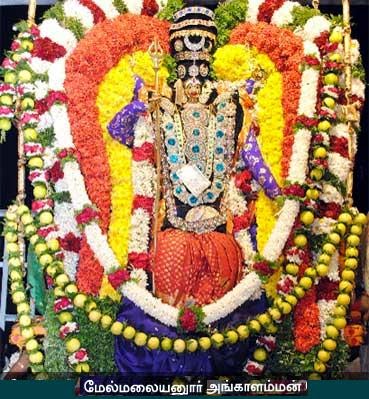
அருள்மிகு அங்காளபரமேஸ்வரி திருக்கோயில் + மேல்மலையனூர்

அருள்மிகு அங்காளபரமேஸ்வரி திருக்கோயில்
+ மேல்மலையனூர்


ஆடி வெள்ளிக்கிழமைகளும், நவராத்திரியும், கார்த்திகை தீபமும், தைப் பொங்கலும், மாசி மாத தேர்த்திருவிழாவும் இங்கு முக்கிய திருவிழாக்களாகும்.

காலை 7 மணிமுதல் மதியம் 12 மணி வரையிலும், பிற்பகல் 2 மணிமுதல் இரவு 8 மணிவரையிலும் திறந்திருக்கும் இந்த சன்னதி அமாவாசையன்று இரவு முழுவதும் திறந்திருக்கும்.
பிரார்த்தனை

கணவனை பிரிந்திருப்பவர்கள் மற்றும் கணவனின் தொந்தரவுக்கு ஆளாகி இருப்பவர்கள் இங்கு வந்து அங்காளபரமேஸ்வரியை வழிபட்டால் பிரச்னை தீரும் என்பது நம்பிக்கை.

அம்மனுக்கு அபிஷேகம் செய்தும், வஸ்திரம் அணிவித்தும் நேர்த்திக்கடன் நிறைவேற்றலாம்.

தலபெருமை:

அங்காள பரமேஸ்வரி ஆதிபராசக்தியின் அம்சமாக இணைவதற்காக பார்வதி என்ற பெயரில் பர்வதராஜனின் மகளாக பிறந்தார். பின் பரமேஸ்வரனை திருமணம் செய்து கயிலையை அடைந்தாள்.

முன்பெல்லாம் சிவன், பிரம்மா இருவருக்குமே ஐந்து தலைதான் இருந்தது. திருமணத்தை நடத்திவைத்த பிரம்மா சிவனைப் பார்ப்பதற்காக கயிலை வந்தார். அப்போது ஏதோ குழப்பத்திலிருந்த பார்வதி ஐந்து தலையுடன் வந்தது சிவன் என கருதி, பிரம்மாவின் காலில் விழுந்து ஆசி வாங்கினார். நிமிர்ந்து பார்த்த போது தான் வந்தது பிரம்மா என்பதை உணர்ந்து வருந்தினார். இருவருக்குமே ஐந்து தலை இருப்பதால் தானே இந்த குழப்பம். எனவே பிரம்மனின் ஒரு தலையை எடுத்துவிடும்படி சிவனிடம் பார்வதி வேண்டினாள்.

பார்வதியின் வேண்டுகோளின்படி சிவனும் பிரம்மனின் ஒரு தலையை கிள்ளி எறிந்தார். இதனால் சிவனுக்கு பிரம்மஹத்திதோஷம் ஏற்பட்டது. சிவனின் பிரம்மஹத்தி தோஷம் போக்குவதற்காகவும், இந்த கலியுகத்தில் மக்களுக்கு அருள் பாலிப்பதற்காகவும் அன்னை பராசக்தி சிவசுயம்பு புற்று வடிவில் அங்காளபரமேஸ்வரியாக மேல்மலையனூரில் அவதாரம் செய்துள்ளார். இவர் வடக்கு நோக்கி அமர்ந்து நம்மை காத்து வருவது ஒர் சிறப்பம்சமாகும். வில்வமே இங்கு தல விருட்சமாகும்.

சரஸ்வதி சாபம் : தன் கணவனின் ஒரு தலை கிள்ளி எறியப்பட்டதை சரஸ்வதி அறிந்தார். உடனே கோபத்துடன் பார்வதியை பார்த்து சரஸ்வதி, ""எனது கணவர் பிரம்மனின் அகோர உருவத்திற்கு காரணமான நீயும் அகோரமாக போவாய்'' என்று சாபமிட்டார்.

இந்த சாபத்தின் பலனாகத்தான் மேல்மலையனூரில் அகோர உருவத்தில் அங்காளபரமேஸ்வரி என்ற நாமத்தடன் அமர்ந்தாள். சிலகாலம் கழித்து திருவண்ணாமலைக்கு சென்று அங்கு பிரம்மதீர்த்தத்தில் நீராடி சாபம் நீங்கி ஒரு மூதாட்டியின் வடிவம் பெற்று மீண்டும் மலையனூர் வந்து தங்கினார். அதன்பிறகு மலையனூரில் உள்ள மீனவர்கள் அங்காளம்மனுக்கு கோயில் கட்டினார்கள்.

தல வரலாறு:


ஒரு முறை தட்சன் தன் மகளான தாட்சாயினியை சிவனுக்கு திருமணம் செய்து வைத்தார். உலகநாயகனான சிவனுக்கு மாமனாராகி விட்டதால் தட்சனுக்கு கர்வம் ஏற்பட்டது. சிவனை பார்க்க கைலாயத்திற்கு சென்ற தட்சனை நந்தி தடுத்தார். இதனால் கோபமடைந்த தட்சன், சிவபெருமானை அழைக்காமலேயே யாகம் ஒன்றை நடத்தினார். தன் தந்தைக்கு ஏற்பட்ட கர்வத்தை போக்க, தாட்சாயினி அகோர உருவம் கொண்டு யாகத்தையும், அதை நடத்திய தந்தையையும் அழித்தாள். அத்துடன் அந்த யாகத்திலேயே விழுந்து தன் உடலை அழித்துக் கொண்டாள். அப்படி உருவ மற்ற அவதாரமாக நின்ற அம்சமே அங்காளி சக்தி ஆகும்.

இதை அறிந்த சிவன் மிகுந்த கோபத்துடன் உருவமற்ற அங்காளியை தனது தோளில் சுமத்தி ஆங்காரமாக நடனம் ஆடினார். அப்போது அங்காளியின் கை துண்டாகி கீழே விழுந்தது. அப்படி விழுந்த இடம் தான் தண்டகாருண்யம் என்ற சக்தி பீடமானது. அந்த தண்டகாருண்யத்தின் ஒரு பகுதியே மேல்மலையனூர் ஆகும். தாட்சாயினி யாகத்தில் விழந்து சாம்பலான இடம் என்பதால் இக்கோயில் பிரசாதமாக சாம்பலைத்தான் தருகிறார்கள்.

தென் காளஹஸ்தி ஸ்ரீ ராகு , ஸ்ரீ கேது கோவில் திருபாம்புரம்

தென் காளஹஸ்தி ஸ்ரீ ராகு , ஸ்ரீ கேது கோவில்
திருபாம்புரம்

தல சிறப்புகள்

திருபாம்புரம் சோழநாட்டுச் சிவதலங்களுள் ஒன்றாகும், சிவாலயங்களுள் தேவார திருபதிகங்கள் பாடப்பெற்ற தலங்களே சிறப்புடையவனவாக போற்றப்படுகின்றன. தேவாரம் பாடபெற்ற தலங்கள் 274. அவைகளுள் 59வது திருத்தலமாக திருபாம்புரம் போற்றப்படுகிறது. இத்தலம் குடந்தை,திருநாகேஸ்வரம், நாகூர், கீழ்ப்பெரும்பள்ளம் மற்றும் காளகஸ்திஆகிய ஐந்து தலங்களின் பெருமையை ஒருங்கே அமையப்பெற்ற பஞ்சலிங்க தலம். எனவே இத்தலம் சர்வதோஷ பரிகாரா தலம் என புராணங்கள் கூறுகின்றன.ஈசனின் பஞ்ச முகங்களை குறிக்கும் வகையில் அமையப்பெற்ற பஞ்சலிங்க தலம்.திருபாம்புரம் கோயில் கம்பீரமான மூன்று நிலைகளை உடைய இராசகோபுரத்தை கொண்டுள்ளது.இராசகோபுரத்திற்கு எதிரே ஆதிஷ தீர்த்தம் உள்ளது. உள்ளே கொடி மரத்து விநாயகர் கொடி மரத்தின்கீழ் இரு:ந்தபடி கிழக்கு நோக்கிய வண்ணம் அருள் பாலிக்கிறார். கொடிமரத்தோடு பலிபீடமும் நந்தியெம்பெருமானும் காட்சி தருகின்றனர்.(கொடிமரம் காலப்போக்கில் அழிந்து விட்டது). இரண்டு பிரகாரங்களை தன்னகத்தே அமையப்பெற்றுள்ளது. கோயிலின் தென்புற வளாகத்தில் திருமலை ஈசுவரர் எனப்படும் மாடக்கோயில் காட்சி தருகிறது.மலை ஈசுவரர் கோயிலில் படிகக்கட்டுகள் உள்ளன. இதில் ஏறி பாம்புரநாதர் கருவறை விமானத்தில் உள்ள சட்டைநதர் சன்னதிக்கு வரலாம்.


மேற்கு பிரகாரத்தின் கன்னிமூலையில் இராசராச விநாயகரும் இதையடுத்து வள்ளி தெய்வயானையுடன் கூடிய முருகரும் காட்சியளிக்கின்றனர். அம்மன் வண்டுசேர் குழலி கிழக்கு வாயிலை கொண்டுள்ளார். அம்மன் மாமலையாட்டி சதுர்புஜத்துடன் தாமரை, உருத்திராக்கா மாலை, அபய, வரத ஹ்ஸ்தங்களுடன் அருள்பாலிக்கிறார். அம்மை மாமலையாட்டியின் (வண்டுசேர் குழலி) சன்னதி இறைவனின் சன்னதிக்கு இடப்புறமாக வடக்கு பிரகாரத்தில் அமை:ந்துள்ளது.

கிழக்கில் பைரவர் , சூரியர் விஷ்ணு, பிரம்மன், பஞ்சலிங்கங்கள், ஆதிசேடன், இராகுகேது, நாயன்மார் நால்வர்,ஆகியோர் காட்சி தருகின்றனர். பாம்புசேரர் கோயில் கருவறை அர்த்தமண்டபம் மகாமண்டபம் முகமண்டபம் என அமை:ந்துள்ளது. மகாமண்டபத்தில் உற்சவதிருமேனிகள் வைக்கப்பட்டுள்ளன. சோமஸ்கந்தர் நடராசர் வள்ளி தெய்வயானையுடன் முருகர் போன்றோர் வீற்றிக்கிரார்கள். இங்குள்ள திருமேனிகளுள் முருகப்பெருமானின் திருமேனி அற்புதமானது. முருகப்பெருமான் வச்சிரதையும் வேலையும் தாங்கி இடக்காலால் மயிலை மிதித்தவாறு காட்சி தருகிறார். இறைவன் சன்னதி கருவறையில் பாம்புரேசுவரர் இலிங்க வடிவாய் எழுந்தருளியிருக்கிறார். ஆதிசேடன் (உற்சவர்) ஈசனை தொழுதவண்ணம் கருவறையில் எழு:ந்தருளியுள்ளார். இக்கருவறையை சுற்றிலும் அகழி உள்ளது. அகழியை மூடி மூன்று புறமும் மண்டபம் உள்ளது. சேடபுரீஸ்வரர் கோயில் கருவறை அதிட்டனத்தில் யாளிவரிசை காணப்படுகிறது. அர்த்தமண்டபத்தில் வடக்குக் கோஷ்டத்தில் புதிதாகத் துர்க்கை ஸ்தாபிக்கபட்டுள்ளாள். இராகுவும் கேதுவும் திருக்கோயிலின் ஈசானிய மூலையில் ஏகசரிரமாகி ஈசனை நெஞ்சில் இருத்தி தனிச்சன்னதியில் எழுந்தருளியுள்ளர்கள்.

சென்னையில் இருந்து திருபாம்புரம் செல்ல மயிலாடுதுறை சென்று அங்கு இருந்து திருவாரூர் செல்லும் சாலையில் உள்ள கொல்லுமாங்குடி சென்று வலதுபுறம் திரும்பி கற்கத்தி சென்று இடதுபுறம் திரும்பி செல்ல திருபாம்புரம் அடையலாம்.